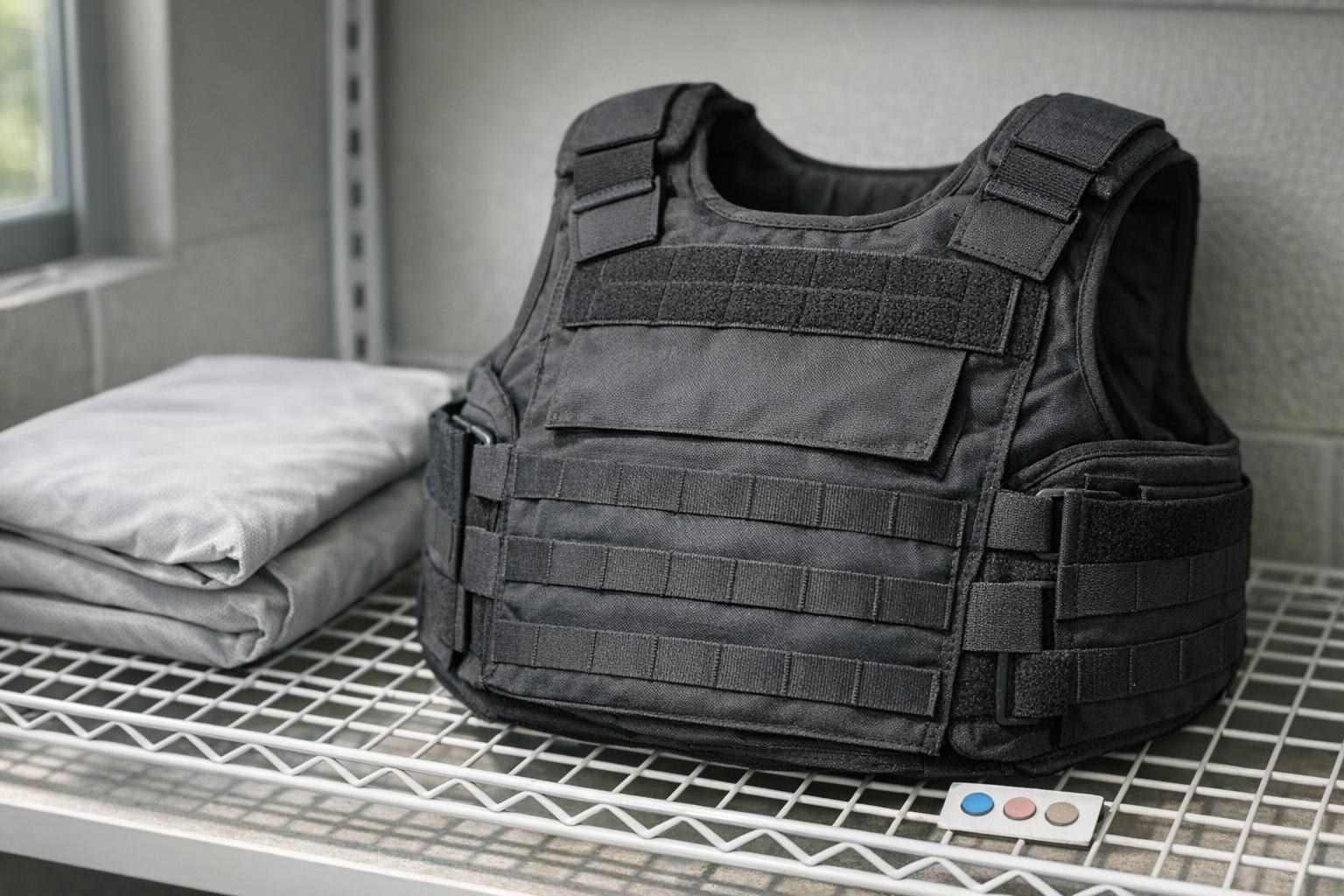
In many cases, a carrier that has been taken to the range for a shooting session can look to have done its job but be stored in a way that will reduce its life expectancy. In addition to sweat from the armor being stored in a carrier, from a vehicle's damp compartment, or from heat left against a window, all will promote deterioration that will only be discovered on subsequent inspections. Good storage is not about finding some clever storage solution but about ensuring that the best environment is created to preserve the shape of the armor(s) and stored in accordance with the written instructions for that specific model. Storage should make the next inspection easier not introduce unknown conditions.
Start with the armor, not the closet
Identify the products you have before searching for a storage location. Soft armor panels, hard body armor plates, carriers, and trauma products all can be stored differently. In many cases the removable ballistic panel has different storage requirements than the carrier which it was issued in. In some cases the exterior of the hard armor plates need to be protected from impacts, cuts and abrasions.
Read the care label, the manual and all product documentation for your protective gear before storage. Storage solutions can vary in terms of required care for the armor itself. Look for alternative documentation such as replacement care labels or contact the manufacturer via the official website and verified communication channels. Don't confuse it with the care instructions for other products.
It is also very important to check your equipment for any signs of physical damage before storing it away. Even seemingly minor damage could pose a problem and this must be noted before storage. Also, remember that visible wear and tear does not necessarily mean that an item's service life has come to an end. For full information on the maximum service life for your armor refer to the maker's instructions and also to any official governing body's equipment-related advice.
Heat changes the storage decision
Heat, while not immediately apparent in storage, is the most surprising factor affecting the stored item. A closed vehicle, attic, shed or storage cupboard near a heat source is often significantly hotter than within a room. Storage in such locations will, upon movement, develop condensation which can penetrate the protective clothing and potentially cause damage upon subsequent use.
A cool, dry and stable environment for storage such as a garage, shed or house is preferred over a heated environment such as a workshop, garage or attics. This also means avoiding storage areas that are exposed to direct sunlight and close to sources of heat. Storage in interior spaces of vehicles such as the trunk of a car is also preferable over vehicle compartments as interior spaces are generally easier to monitor.
As with folding the armor, weight must not be placed on flexible panels. Also, armor must not be folded or bent around narrow hangers, unless the manufacturer in writing states otherwise. All equipment can be stored flat, but some models must be stored in a specific way to preserve their form. When in doubt, store the item in a way to avoid compression, sharp folds, etc.
Moisture needs a deliberate routine
Note that there are many conditions under which moisture can be introduced to a unit. Packaged in a slick bag, equipment can be protected from dust but have the dampness sealed within. Store items on open shelves and they will get dust in the home etc., but they will not get damaged accidentally.
Do not dry equipment in clothing dryers, on radiators, with heat guns or with other sources of high heat. Permitting the exterior of soft armor to dry in a clean, shaded and well-ventilated area as instructed by the manufacturer, is not sufficient time to allow moisture to have dried from the inside of the item. Allow time to pass and then check before storing away.
Cover the protective equipment with a breathable protective cover if required to protect against dust. Remember that storage in hard cases or in sealed containers also requires clean, dry equipment to be placed inside them and that these containers do not solve the moisture problem. Desiccants can be stored in suitable containers but do not replace dry storage, ventilation and recommended storage according to the manufacturer's instructions.
Clean without treating armor like clothing
Remember to gently clean clothing like carriers, straps, etc. which come into contact with the armor before storing it away. If a soft armor item comes in detachable components then make sure you read the instructions on how to remove them for storage. In general, a slightly damp cloth for gentle cleaning is best but check the label on your item as some may require special treatment.
Washable parts can be washed with gentle soap, by hand and in warm water. Now, there is nothing to stop you gently washing off sweat or grime from the external parts of load bearing carriers etc but note that specific parts may need special care. Remember also, never wear your armor whilst in the gym!
If some impact or spillage has occurred it is best to write down as much as possible about the incident (date, place, event etc.) so this can be referred to later, even though it may be better to get the item checked by a professional.
Build a storage check you will actually use
All practical solutions are short. A smart owner can check before storing equipment for 1) dryness, 2) cleanliness for storage and 3) damage. Note how panels are stacked, check closures for excessive strain and make sure that there is no weight on the panels. Store smartly all the equipment's accessories to prevent rubbing, leaking or even sweating and subsequently leaving unsightly marks on the protective parts of armor.
Remember when you use your stored gear to check it too for signs of wear! We've listed a few signs for you that can mean there's been some kind of damage to your gear and you should get in touch with the manufacturer. Check for moisture, unusual smells, any stiffness or surface changes, looseness of stitching or other signs of wear and tear.
The best method for storage of your own protection gear is based on the type of gear itself and the individual storing it. A simple labeled shelf in a good location could be far better than a costly case which may be left opened for long periods. A good protective case would be sensible for the busy household or workshop but otherwise storage should aim to minimize the impact of heat, moisture, compression and confusion, whilst allowing easy inspection.
When you compare the care advice for your protection equipment to the storage advice given on this website, remember that the advice on this website is general and may conflict with the specific manufacturer care guidelines for a particular model of protection equipment. Always check the most up-to-date official care guidelines for that particular item and get expert advice if in doubt as to whether something is damaged, how long it lasts for or how it should be used.